
Confidence While Fear Is Present

Confidence does not require the absence of fear. It is the willingness to continue creating, performing, and releasing music while fear is still present.
Musical confidence is not waiting for outward validation or support before taking action. It is continuing to write, compose, perform, and release your work—even while dealing with doubt, fear, limited support, criticism, and inward intimidation.
This article was inspired by the May NoNameMusik Topic , which explored the importance of moving forward instead of allowing uncertainty to stop you. This time, we are going deeper into the challenges that songwriters, musicians, producers, and performers confront daily.
Beginning does not automatically eliminate fear. You have to learn how to continue while facing it.
May introduced the decision to move forward. Now we are exploring the harder question:
Recognizing What You Are Facing
Fear, doubt, lack of support, criticism, and inward intimidation may appear together, but they do not always operate in the same way.
Nagging fears are thoughts about what might happen.
Doubts are questions about your ability, judgment, or decisions.
Lack of support is the absence of encouragement, attention, or practical help.
Naysayers are people who actively discourage or dismiss your work.
Inward intimidation is especially important. This happens when the artist begins intimidating themselves—sometimes before anyone else has even heard or reacted to the music.
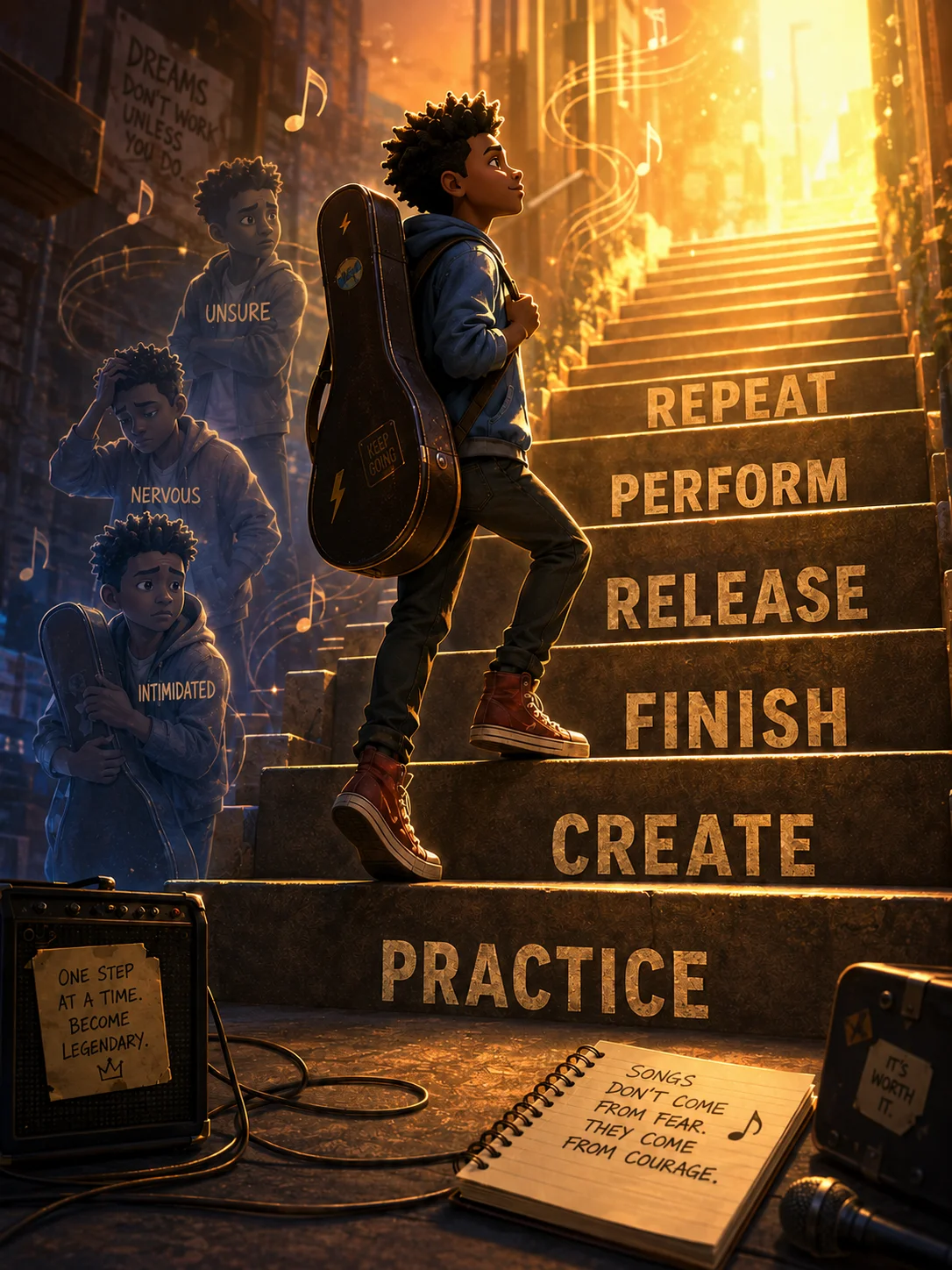
Sometimes the loudest naysayer is not outside the room. It is the voice inside the artist that predicts rejection before the music has even been given a chance.
That voice can take an unfinished idea and immediately declare that it will fail. It can turn one mistake into proof that you are not talented. It can make silence from others feel like a final judgment on your ability.
When that happens, the artist may begin treating a fearful prediction as though it were an established fact.
Fear says something might go wrong.
Inward intimidation says that because something might go wrong, you should not try.
Confidence interrupts that conclusion. It does not always make the fearful thought disappear, but it refuses to let the thought make the final decision.

Fear During the Creative Process
Fear can enter at almost every stage of making music.
While writing a song, it may sound like:
- “This idea is not good enough.”
- “Someone has already written something similar.”
- “People might not understand it.”
- “Maybe I am not a real songwriter.”
- “What if I cannot finish what I started?”
These thoughts can cause an artist to judge an idea before giving it time to develop. A lyric that needed revision gets abandoned. A melody that needed exploration is dismissed. A song that could have become something meaningful never gets the chance to grow.
Songwriting often requires uncertainty. You may not know where the song is going when the first lyric, chord, rhythm, or melody appears. Confidence during this stage is not knowing that every idea will work. It is being willing to explore the idea long enough to discover what it can become.
The same principle applies to composing and producing. Choosing sounds, changing arrangements, removing parts, and testing different directions all involve judgment. Some decisions will work, while others will not. That does not make the creative process a failure. It is part of the process.

Fear of Releasing Music
Finishing a song creates another challenge: allowing other people to hear it.
An artist preparing to release music may fear:
- Low streams or views
- Silence from friends and family
- Negative comments
- People questioning the quality
- Feeling embarrassed while promoting it
- Comparing the release with established artists
- Discovering that the response is smaller than expected
Before the release, the music belongs mostly to the artist. After the release, people can react to it, overlook it, criticize it, misunderstand it, or connect with it in unexpected ways.
That loss of control can feel intimidating.
However, keeping the music hidden does not protect its potential. It prevents the work from reaching the people who may have appreciated, understood, or needed it.
A quiet response also does not automatically mean that the music lacks value. Sometimes the right audience has not discovered it yet. Sometimes the promotion was limited. Sometimes people listened without responding publicly. Sometimes the song becomes meaningful to someone much later.
Releasing music requires accepting that you cannot control every response. You can control whether you complete the work, present it honestly, and give it an opportunity to be heard.
Successful People Still Experience Fear
More successful people are openly revealing that fear, doubt, and negative thoughts were present during some of their greatest achievements.
World-famous singers have admitted that fear can overtake them before performing in a sold-out venue filled with thousands of people. Sometimes the intimidating thoughts and feelings become overwhelming before they walk onstage or even while they are performing.
From the audience’s perspective, they delivered a great performance. The crowd may never have realized the inward battle the performer endured. For some artists, this happens repeatedly—even after receiving worldwide recognition and some of the music industry’s highest accolades.

That leads to an understandable question:
A common answer from experienced performers is that their love of singing, performing, and connecting with an audience is stronger than the fear they feel.
They are not always claiming that fear has disappeared. Instead, they have accepted that fear may coexist with performing. Their passion is given the dominant position in their minds, so fear is present without being placed in control.
An artist may admit:
Some performers have even said that their greatest performances occurred on nights when their fear felt the strongest. They could not allow it to stop them because their love of performing and connecting with the audience outweighed the intimidation.
The lesson is not that we must become famous before learning how to confront fear. The lesson is that success does not automatically remove the inward battle.
Passion Does Not Erase Fear—It Outweighs It
The solution is not always to eliminate every nagging fear, doubt, intimidation, or feeling of inferiority.
You can recognize that those thoughts and feelings are present while allowing your love for the goal to occupy more of your attention. When passion becomes more dominant, fear may continue speaking, but it no longer gives the instructions.
This is not about pretending negative feelings do not exist. Ignoring fear and refusing to obey fear are two different things.
“I know this fear is here, but I also know why I started.”
“I feel uncertain, but I am still going to finish the song.”
“I am nervous about the performance, but I still want to connect with the audience.”
“I do not know how people will respond, but I am still going to release the music.”
Confidence becomes visible through the action that follows the feeling.

Confidence During Live Performance
Live performance can bring fear into its most visible form.
The performer may think:
- “I do not sound as good as someone else.”
- “Why am I wasting my time?”
- “I do not have what it takes.”
- “Why should I bother?”
- “I keep making mistakes.”
- “What if I forget something?”
- “What if the audience does not respond?”
A strong performance mindset is not necessarily:
It is:
A missed note, forgotten lyric, technical problem, or unexpected reaction does not have to determine the entire performance. The audience may not even notice every mistake that feels enormous to the person onstage.
Confidence allows the performer to stay connected to the music instead of mentally leaving the performance to examine every imperfection.
The goal is not to convince yourself that mistakes are impossible. The goal is to know that one imperfect moment does not remove your ability to continue.

Keep Looking Toward the Destination
Consider what happens when you are driving a car.
You are aware that buildings, houses, signs, and other objects exist to your left, right, and behind you. You do not demand that all those things be removed before you begin driving toward your destination.
You understand that they will remain there while you travel.
Although you remain aware of your surroundings, your main attention stays on the road ahead. If you focused only on everything beside or behind you, you would struggle to continue safely toward your destination.
The same idea can be applied inwardly.
Many people believe they must remove every doubt, fear, and negative feeling before moving forward with their goals, dreams, or visions. They wait to feel completely secure before beginning, finishing, performing, or releasing their work.
But during life’s journey, inner fear and intimidation may remain present while you are still moving toward your destination.
Fear can be beside you without driving the car.
Doubt can make noise without choosing the direction.
Criticism can exist behind you without becoming the destination.
Confidence is continuing to steer.
You Are Not Alone in the Battle
Artists at every level have confronted thoughts such as:
- “I am afraid to release my song.”
- “How do I stop overthinking my songwriting?”
- “Nobody supports my music.”
- “How do I overcome stage fright?”
- “I do not think my music is good enough.”
- “I am scared to post my music.”
- “How do I finish my songs?”
- “How should I handle criticism as an artist?”
Knowing that successful artists still experience similar struggles should not make fear seem unbeatable. It should remind you that fear is not proof that you are incapable.
People do not always succeed because they stopped experiencing doubt. Often, they succeeded because they continued doing the work while doubt remained present.
The difference was not necessarily the absence of negative thoughts. It was which thoughts received the most attention and authority.

Focus on What You Are Trying to Accomplish
A basketball player was once interviewed after their team completed an extraordinary comeback.
The interviewer asked what the player was thinking while the team was losing throughout most of the game.
The player explained that their mind was so focused on winning that they did not have time to concentrate on or talk about losing. They continued to see themselves as a winner even while the scoreboard showed that they were behind.
The player did not deny the score. They knew the team was losing.
But the temporary situation did not replace the goal in their mind.
This is the same inward discipline an artist can practice. You may recognize that you are afraid, unsupported, inexperienced, or disappointed with your current results. You do not have to deny any of those circumstances.
The question is whether the circumstance will receive more attention than the destination.
If the goal is to finish the song, keep returning your attention to finishing.
If the goal is to perform, keep returning your attention to communicating the music.
If the goal is to release your work, keep returning your attention to giving the music an opportunity to reach someone.
Putting Confidence Into Practice
We now have examples from successful singers, performers, athletes, and other people who continued while facing inward pressure.
The only thing left is to put the principle into practice within ourselves.
It all leads to one central solution:
You have to love the goal enough to let that love overshadow the fear.
That does not mean you will feel inspired every day. It does not mean criticism will never hurt or that doubt will never interrupt your thoughts. It means you repeatedly decide which voice will control your next action.
You may write while fear is present.
You may finish while doubt is present.
You may release the music while support is limited.
You may perform while your body still feels nervous.
You may continue even though part of you wants to retreat.
Every time you do, you are practicing confidence.
Confidence is not merely something you feel before taking action. Sometimes it is something you build because you took action. Each completed step becomes evidence that fear can be present without being in control.
You do not have to wait for fear to leave the room.
You only have to stop giving it the final word.
Next Month’s September Topic
Now that you are willing to create or perform while fear is present, another voice may appear once the work begins—the voice that questions every lyric, note, sound, release, and creative decision.
Moving forward takes courage, but finishing the music also requires learning when to trust your own creative judgment.

Revisit a Previous Music Topic

From the Archive · July
The Subject: The Right Sound Tells the Right Story
Revisit the July Music Topic about the importance of choosing the right sound for a movie scene.
Read Previous Article →